
Plate Buckling in Crane Girders
In crane girder design, material yield strength is not always the governing resistance criterion.
For slender plate elements, instability may occur before the material reaches its yield stress.
This phenomenon is known as plate buckling and plays a central role in crane girder verification according to EN 13001-3-1.
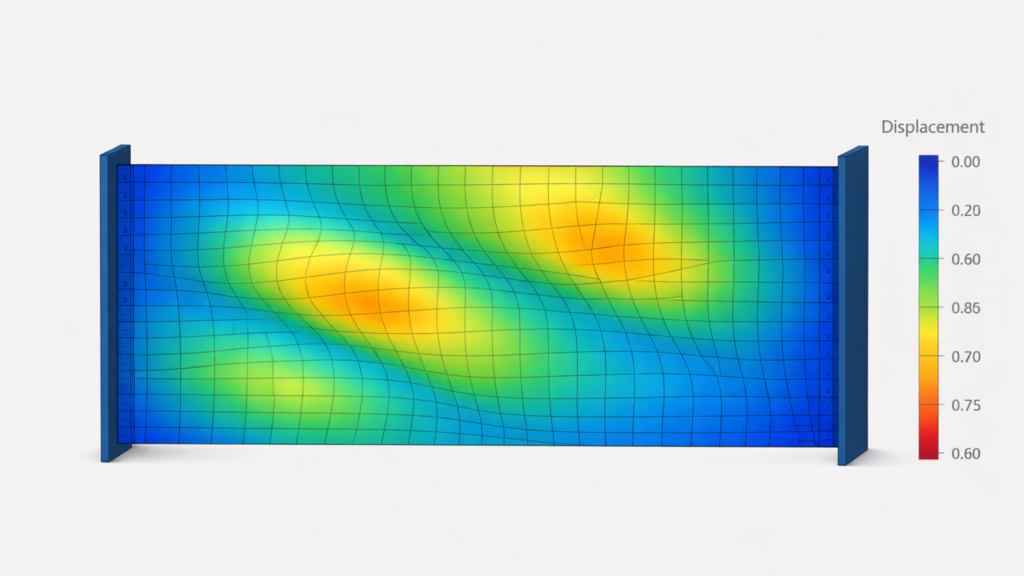
Slender Plate Elements in Crane Girders
A typical crane girder consists of welded plate elements:
- Web plate
- Compression flange
- Stiffened or unstiffened panels
When subjected to bending, the upper flange and parts of the web are in compression. If these elements are sufficiently slender, they may lose stability locally before reaching yield stress.
This means that structural resistance is controlled by instability rather than material strength.
From Yielding to Buckling-Controlled Resistance
In classical strength checks, stress is compared directly to yield strength:
σ ≤ fy
However, for slender plates under compression, the effective resistance is reduced. Instead of full yield capacity, a reduced design stress is considered:
fb,Rd = k fy γM
Where:
- k is a reduction factor related to plate slenderness
- γM is the material partial safety factor
The reduction factor accounts for the fact that instability may limit capacity before yielding occurs. The more slender the plate, the lower the effective resistance.
Non-Dimensional Slenderness
Buckling behaviour depends on a non-dimensional slenderness parameter. This parameter reflects the relationship between:
- Plate width
- Plate thickness
- Boundary conditions
- Material properties
Higher slenderness leads to a greater reduction in design resistance. Therefore, increasing plate thickness or improving boundary restraint directly improves buckling resistance.
Why This Is Critical in Crane Girders
Crane girders are particularly sensitive to plate buckling because:
- Web plates are often slender
- Compression zones are highly stressed
- Wheel loads introduce localized compression
- Welded construction may include unstiffened panels
Even when global bending stresses are moderate, local buckling may govern the design. Ignoring plate instability may lead to overestimation of structural capacity.
Design Philosophy
EN 13001-3-1 treats plate buckling explicitly by introducing reduction factors that modify the allowable stress in compression zones.
The approach ensures that:
- Slender plate elements are assessed realistically
- Instability is considered before yielding
- Design remains consistent with actual structural behaviour
This prevents unsafe reliance on material strength alone.
Conclusion
In crane girder design, yield strength does not always define the limit state.
For slender plate elements subjected to compression, buckling may govern structural resistance before material yielding occurs.
By accounting for plate slenderness and introducing reduction factors, EN 13001-3-1 provides a realistic framework for evaluating compression resistance in welded crane girders.