
Why Different Plate Elements Behave Differently
In crane girder design, not all plate elements respond to compression in the same way.
The web and the compression flange are subjected to different stress states, boundary conditions and instability mechanisms.
Understanding these differences is essential for realistic buckling verification according to EN 13001-3-1.
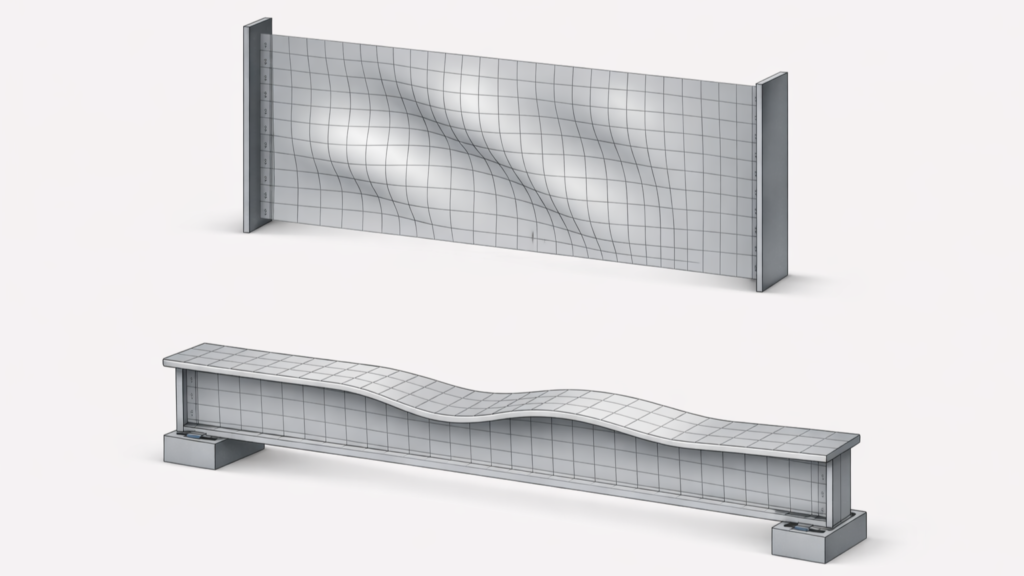
Stress State in the Web
The web of a crane girder primarily carries:
- Shear forces
- Bending-induced longitudinal stresses
- Local compression from wheel loads
Web panels are usually supported by:
- Flanges at top and bottom
- Vertical stiffeners (if present)
Because of this support, the web behaves like a plate panel with restrained edges. Its buckling behaviour depends strongly on:
- Panel aspect ratio
- Stiffener spacing
- Web thickness
Even though the web is often slender, its boundary conditions may provide significant restraint.
Compression Flange Behaviour
The upper flange is typically subjected to global compression from bending. Unlike the web, the flange may have:
- One free edge
- Limited lateral restraint
- No intermediate stiffening
This makes the compression flange more sensitive to:
- Local plate buckling
- Lateral torsional effects
In many cases, the flange may reach instability at lower stress levels than the web.
Different Buckling Mechanisms
Web buckling and flange buckling differ in several ways:
- Web panels often buckle in a plate field pattern
- Flanges may buckle locally along their width
- Interaction with shear is more relevant for webs
- Interaction with global bending is more relevant for flanges
Because of these differences, reduction factors are not identical for web and flange elements. Each plate component must therefore be assessed according to its specific stress condition and boundary support.
Influence of Stiffening
Stiffeners significantly improve web stability by:
- Reducing panel width
- Increasing restraint
- Limiting out-of-plane deformation
Flange stability, however, depends mainly on:
- Thickness
- Width-to-thickness ratio
- Lateral restraint from the web and bracing
Optimizing stiffener layout can therefore improve web performance without necessarily affecting flange behaviour.
Why This Distinction Matters
If web and flange are treated as identical compression elements:
- Buckling resistance may be overestimated
- Critical elements may be overlooked
- Design thickness may be incorrectly selected
Crane girders require element-specific stability verification to ensure reliable resistance under compression.
Conclusion
Web and flange elements in crane girders exhibit different buckling behaviour due to their distinct stress states and boundary conditions. While web panels benefit from edge restraint and stiffening, compression flanges are often more vulnerable to local instability.
Recognizing these differences allows for accurate and efficient stability verification in accordance with EN 13001-3-1, ensuring that each plate element is assessed according to its actual structural behaviour.