
Serviceability Requirements According to FEM Practice
In crane girder design, strength and stability are not the only governing criteria. Even when stresses and buckling checks are satisfied, excessive deflection may impair crane operation.
Deflection control is therefore a fundamental serviceability requirement in crane main girder design.
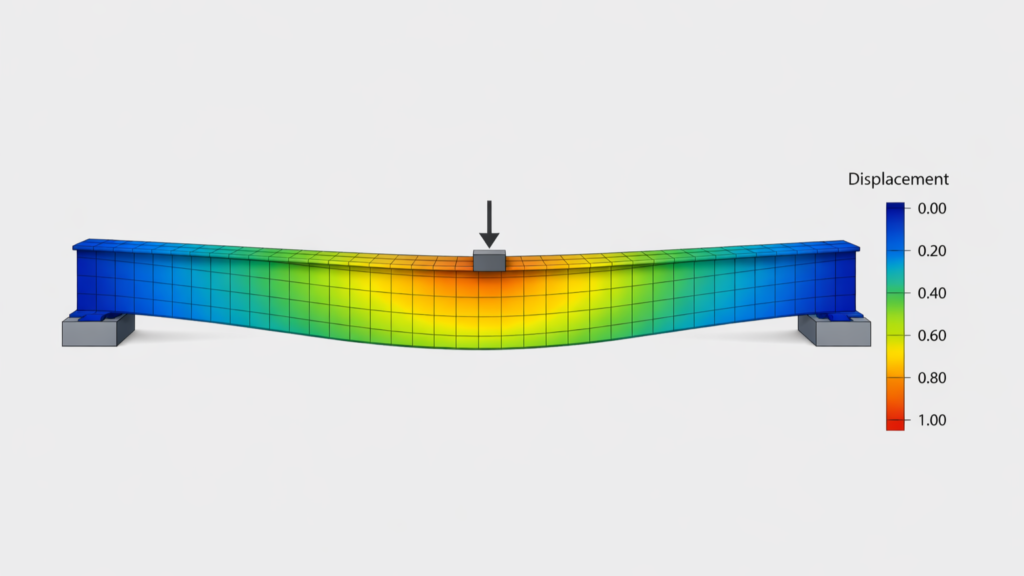
Why Deflection Matters in Crane Structures
Unlike ordinary floor beams, crane girders support moving mechanical equipment. Excessive vertical deflection may lead to:
- Misalignment of rails
- Increased wheel wear
- Irregular crane travel
- Additional dynamic effects
- Reduced operational precision
In severe cases, poor alignment may affect safety and long-term structural performance.
Vertical Deflection Under Service Load
Deflection is typically evaluated under service-level loading conditions, considering:
- Girder self-weight
- Trolley weight
- Rated hoisted load
The maximum deflection generally occurs when the trolley is positioned near mid-span.
Although FEM 1.001 does not always prescribe a single universal limit, common engineering practice adopts limits proportional to span length.
A typical reference value often used in crane engineering is:
δmax ≤ L 500
This ensures adequate stiffness for proper crane operation.
Interaction Between Deflection and Dynamic Behavior
Deflection and vibration are closely related.
A more flexible girder:
- Has lower natural frequency
- Exhibits larger dynamic response
- May amplify oscillations
Thus, stiffness requirements influence both static serviceability and dynamic performance.
Optimizing girder stiffness is therefore a balance between:
- Structural weight
- Fabrication cost
- Operational quality
Practical Design Considerations
Increasing stiffness to reduce deflection may involve:
- Increasing girder depth
- Increasing flange thickness
- Optimizing cross-section geometry
However, excessive stiffness increases material consumption and cost.
Serviceability design, therefore, requires a rational compromise between performance and economy.
Conclusion
Deflection control in crane main girder design ensures proper alignment, operational precision and long-term serviceability. While strength and stability address structural safety, deflection limits govern usability and performance.
By maintaining adequate stiffness relative to span, designers ensure that crane operation remains stable, predictable and efficient throughout its service life.