
Local Effects Beneath the Rail in Crane Girders
While global bending governs overall stress in a crane girder, wheel loads introduce highly localized effects that must be assessed separately.
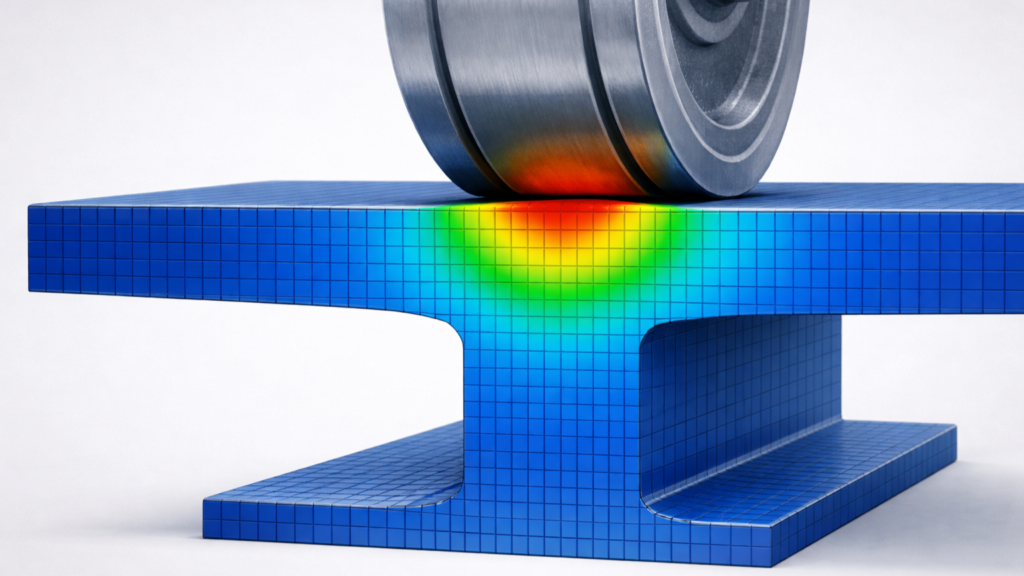
Under each wheel, concentrated vertical forces generate transverse compression in the web and flange region beneath the rail. This local stress state differs significantly from global bending and may control design in critical zones.
Nature of Wheel Load Introduction
Wheel loads are transmitted:
- From the wheel
- Through the rail
- Into the flange
- And further into the web
The load is not uniformly distributed across the girder width. Instead, it spreads over a limited contact zone. This produces:
- High localized compressive stresses
- Stress gradients across the web thickness
- Interaction between bending and local compression
These effects require dedicated verification.
Local Compression vs Global Bending
Global bending produces longitudinal stress along the girder axis.
Transverse compression beneath the wheel acts:
- Perpendicular to the web plane
- Over a limited effective width
- With high intensity near the load introduction point
This localized compression may lead to:
- Local plate buckling
- Web crippling
- Reduced load-carrying capacity in the wheel zone
Even when global stresses are moderate, local effects may govern.
Influence of Geometry
Local resistance depends strongly on:
- Web thickness
- Flange thickness
- Distance between stiffeners
- Rail geometry
Slender webs are more sensitive to instability under concentrated transverse forces.
Stiffeners placed near wheel positions significantly improve resistance by limiting panel deformation.
Interaction with Other Effects
Transverse compression does not act in isolation. It interacts with:
- Global bending stress
- Shear stress in the web
- Residual stresses from welding
This combined stress state increases the complexity of verification compared to uniform compression. Proper design must therefore ensure that local wheel load effects are assessed independently from global bending checks.
Why This Check Is Essential
Ignoring local transverse compression may result in:
- Web deformation under the rail
- Crack initiation near stiffeners
- Premature local instability
Crane girders experience repeated wheel passages during service life, making local zones particularly critical for durability.
Conclusion
Wheel loads introduce localized transverse compression effects beneath the rail that differ fundamentally from global bending behaviour. These local stresses may govern web thickness, stiffener spacing and detailing in crane girders.
A complete structural assessment must therefore include verification of transverse compression zones in addition to global bending and fatigue checks.