
When Web Slenderness Governs Structural Resistance
In crane girder design, the web does not carry bending alone.
It also transfers significant shear forces between supports and wheel load positions.
For slender webs, shear resistance may be governed not by material yielding, but by shear buckling.
According to EN 13001-3-1, shear stability must be verified explicitly when web slenderness exceeds certain limits.
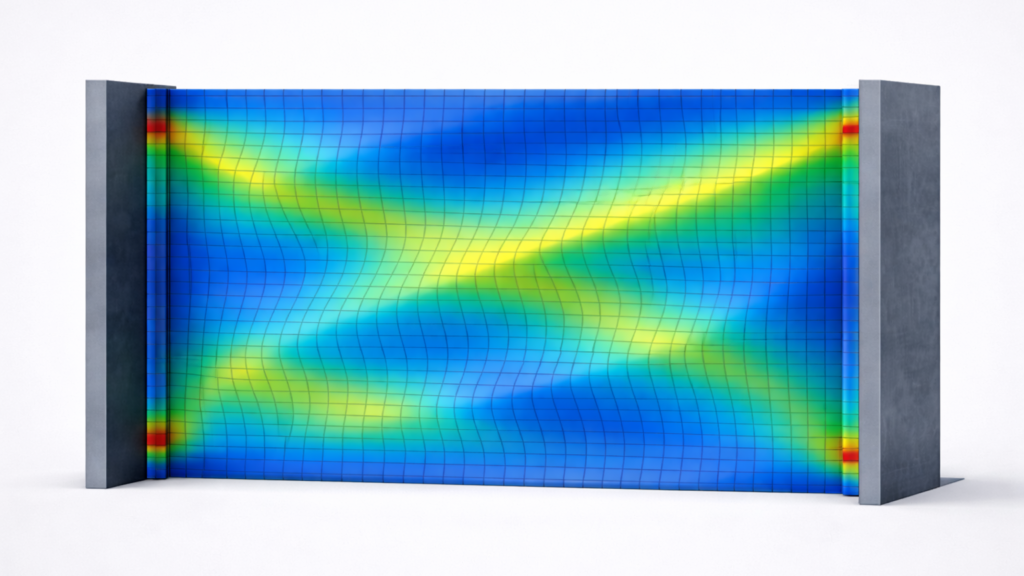
Shear in Crane Girders
Shear force in the girder web is highest:
- Near supports
- Under concentrated wheel loads
- In regions of high reaction
Unlike bending stress, which peaks at mid-span, shear demand is typically critical closer to the supports. The web plate resists this shear through its thickness and panel geometry.
Slender Web Behaviour Under Shear
When the web is relatively thick, shear stress may reach material yield strength before instability occurs. However, when the web is slender:
- Out-of-plane deformation may develop
- Diagonal tension fields may form
- Instability may occur before yielding
In this case, resistance is controlled by buckling rather than by yield stress.
Shear buckling reduces the effective load-carrying capacity of the web.
Influence of Web Geometry
Shear buckling behaviour depends on:
- Web depth-to-thickness ratio
- Panel aspect ratio
- Presence and spacing of vertical stiffeners
- Boundary restraint conditions
Greater web depth or reduced thickness increases susceptibility to shear instability. Stiffeners reduce effective panel size and improve stability.
Interaction with Bending
In practice, web panels are subjected to:
- Shear stress
- Longitudinal bending stress
- Local compression from wheel loads
These stresses interact, influencing overall stability behaviour. Shear buckling cannot be assessed independently of the stress state in the web panel.
Why Shear Buckling Is Often Overlooked
Designers may focus primarily on bending resistance, assuming shear is secondary. However, in crane girders:
- Wheel loads create high localized reactions
- Web panels may be intentionally slender for weight efficiency
- Service class may require long-term durability
Under these conditions, shear buckling may become the governing limit state.
Conclusion
Shear buckling represents a critical stability phenomenon in slender crane girder webs. When web geometry exceeds certain slenderness limits, resistance is controlled by instability rather than material yielding.
A comprehensive crane girder design must therefore include explicit verification of shear stability in addition to bending, local compression and fatigue checks.