
What Controls Crane Vibration?
Vibration is an inherent part of overhead crane operation. Whenever the bridge accelerates, stops, or the trolley moves along the span, dynamic effects are introduced.
The key parameter governing this behavior is the natural frequency of the crane girder. Understanding it is fundamental to predicting vibration response and ensuring stable crane operation.
Basic Definition
The natural frequency of a structure describes how it tends to vibrate when disturbed. For a simplified single-degree-of-freedom representation, the frequency is given by:
f = 1 2π √ K M
Where:
- f – natural frequency
- K – structural stiffness
- M – equivalent mass
This expression immediately shows two governing parameters:
- Increasing stiffness raises the frequency
- Increasing mass lowers the frequency
Structural Interpretation for Crane Girders
In overhead cranes:
- K represents the flexural stiffness of the main girder
- M represents the equivalent mass participating in vibration
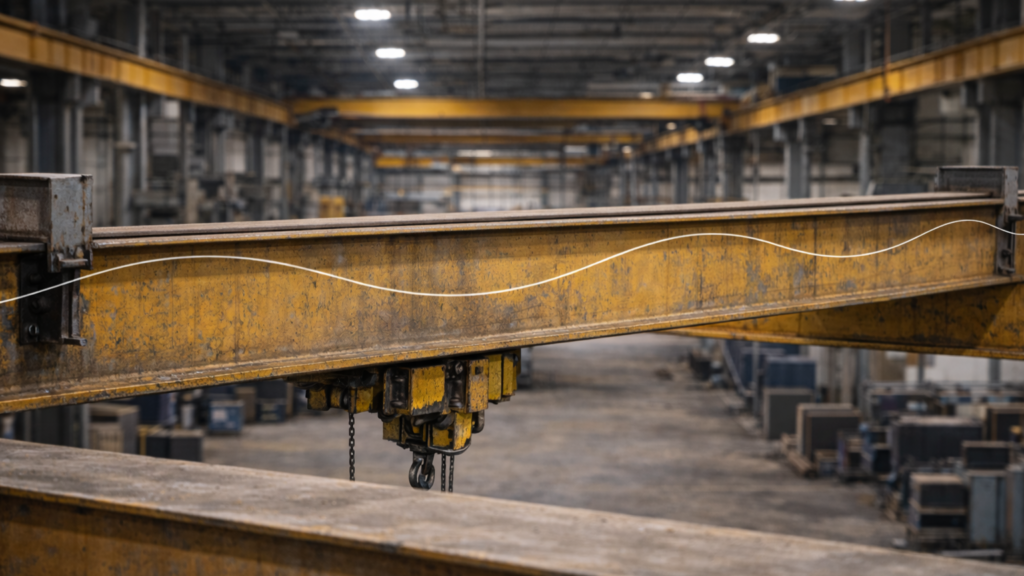
The girder behaves as a flexible beam spanning between runway supports. When excited, the system oscillates primarily in bending.
Because the frequency depends on the ratio K/M, two cranes with similar span but different girder stiffness or trolley mass may behave very differently in operation.
Why Frequency Matters
Natural frequency is not merely a theoretical parameter. It directly influences:
- Vibration amplitude during acceleration and braking
- Hook oscillation behavior
- Operator comfort
- Structural dynamic response
If the natural frequency is too low, oscillations become slow and more noticeable.
If it is too high, structural weight and cost may increase unnecessarily.
Proper frequency design is therefore a balance between stiffness, mass and economic considerations.
Role of Span Length
Although not explicit in the basic formula, span length strongly influences stiffness. For beam-type structures, stiffness is proportional to:
K ∝ E I L3
This cubic dependence means that increasing span significantly reduces stiffness and therefore reduces natural frequency.
Long-span cranes are therefore more susceptible to dynamic issues unless girder stiffness is increased.
Simplified Dynamic Model
In practical engineering calculations, the crane girder is often idealized as:
- A beam with equivalent stiffness
- A concentrated equivalent mass at mid-span
This simplification allows estimation of fundamental frequency without performing full modal analysis. Such approximations are particularly useful during preliminary design stages.
Conclusion
The natural frequency of an overhead crane girder is governed by the balance between stiffness and mass. It serves as a key dynamic parameter influencing vibration behavior, operational stability and user comfort.
A clear understanding of how stiffness, mass and span interact provides the foundation for rational crane vibration assessment.
In the article XXX, we examine how vertical natural frequency changes when the crane operates with and without load.