
Natural Frequency With and Without Load
In practical crane operation, the structure does not vibrate under a single constant condition.
The natural frequency of the girder changes depending on whether the crane is operating empty or carrying a load. This change is governed primarily by variation in the equivalent vibrating mass.
Vertical Natural Frequency Without Load
For vertical vibration of the girder without lifted load, the natural frequency can be expressed as:
fy1 = 1 2π √ K1 M1
Where:
- K1 – vertical stiffness of the girder
- M1 – equivalent mass without lifted load
In this condition, the vibrating system includes:
- Girder mass contribution
- Trolley mass
The absence of hook load means the effective mass is lower, and therefore the natural frequency is higher.
Vertical Natural Frequency With Load
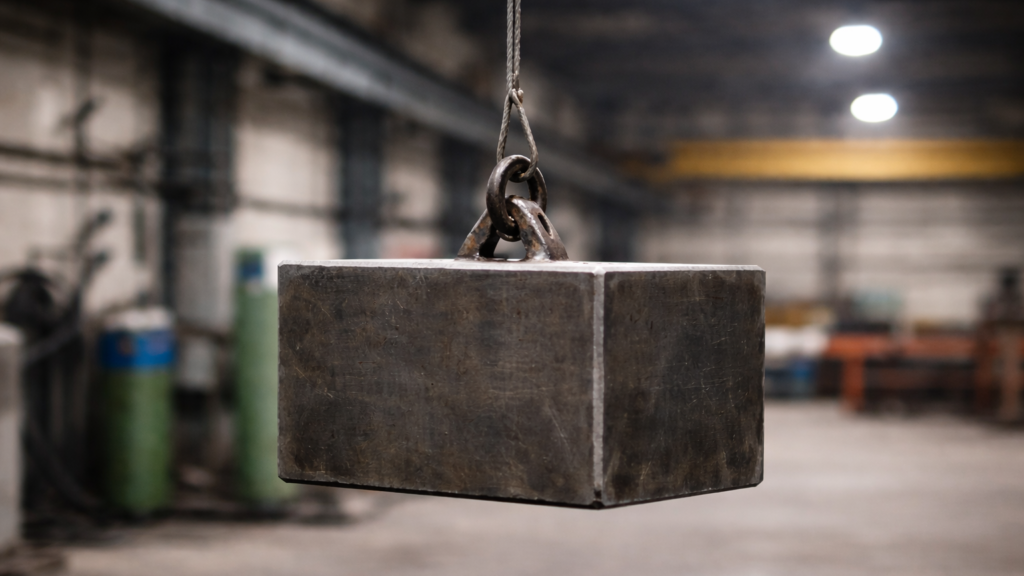
When the crane lifts a load, the vibrating mass increases. The natural frequency becomes:
fy2 = 1 2π √ K1 M2
Where:
- M2 includes girder mass
- Trolley mass
- Hook and lifted load mass
Since M2 > M1, the frequency decreases:
fy2 < fy1
This reduction is a direct consequence of increased dynamic inertia.
Why the Difference Matters
The operational state of the crane determines its dynamic behavior.
With load:
- Oscillation becomes slower
- Vertical deflection response increases
- Dynamic amplification effects may become more noticeable
Without load:
- Frequency is higher
- Structure appears stiffer dynamically
- Vibrations decay more rapidly
Design must account for both states.
Engineering Interpretation of Equivalent Mass
The equivalent mass used in simplified calculations does not equal the total physical mass of the crane. Instead, it represents the portion of mass effectively participating in the vibration mode.
For vertical bending of a simply supported girder:
M1 = 17 35 Gq + MV n
M2 = 17 35 Gq + MV + Mq n
Where:
- Gq – girder mass
- MV – trolley mass
- Mq – hook and lifted load
- n – number of girders
The coefficient 17 35 reflects modal mass participation in the first bending mode.
Not all structural mass contributes equally to vibration.
Recommended Vertical Frequency
A commonly adopted general guideline is:
fy ≥ 2 Hz
However, for very long spans, strictly enforcing this limit may lead to excessive structural weight.
In practice, recommended minimum frequency may be defined as a function of span length. This reflects the trade-off between dynamic performance and structural economy.
Conclusion
The vertical natural frequency of an overhead crane is not a fixed structural property but a dynamic parameter that varies with operating conditions. When the crane carries a load, the equivalent vibrating mass increases, leading to a measurable reduction in natural frequency. This change directly influences the dynamic response of the structure, including oscillation characteristics and deflection behavior.
For this reason, both unloaded and loaded conditions must be evaluated during the design stage. Ignoring the effect of lifted mass may result in underestimating dynamic sensitivity and misjudging operational performance. A realistic vibration assessment therefore requires careful consideration of equivalent mass and its variation during crane operation.