
Why 95% and 99.9% Reliability Change Your Shaft Size
Fatigue strength is not a single deterministic value. It is a statistical result derived from experimental testing. Even under identical loading conditions, different specimens of the same material will fail at different numbers of cycles.
This scatter makes reliability a fundamental parameter in fatigue design.
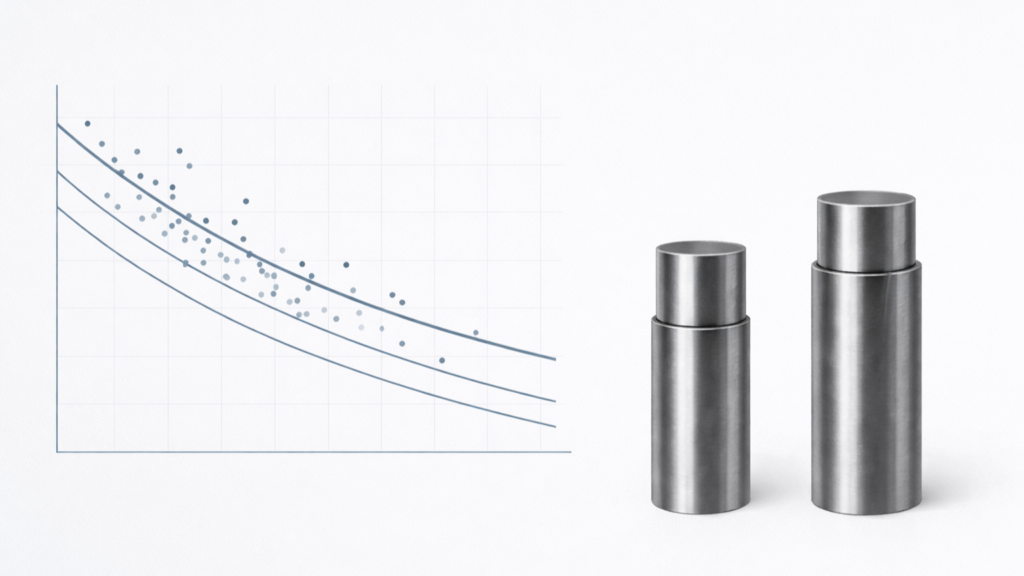
Statistical Nature of Fatigue Data
The endurance limit obtained from laboratory testing represents a statistical mean value. However, real components are not identical to laboratory specimens:
- Material microstructure varies
- Surface conditions differ
- Manufacturing introduces imperfections
- Residual stresses may be present
As a result, fatigue strength follows a probability distribution. Designing without considering this variability may lead to unexpected failures.
Reliability Factor in Stress-Life Design
To account for statistical scatter, the endurance limit is reduced using a reliability factor:
Se = ke Se*
Where:
- Se* – endurance limit after surface, size, load and temperature corrections
- ke – reliability factor
Typical values:
- 95% reliability → ke ≈ 0.868
- 99% reliability → ke ≈ 0.814
- 99.9% reliability → ke ≈ 0.753
Increasing reliability reduces the allowable endurance limit. This directly affects allowable stress and required shaft diameter.
Practical Impact on Design
Because fatigue strength enters the design inequality directly, even a modest reduction in Se may require:
- Larger shaft diameter
- Increased weight
- Higher material cost
For high-cycle fatigue design, this effect is significant. For example, increasing reliability from 95% to 99.9% reduces allowable fatigue stress by more than 13%. This change may be the difference between passing and failing a fatigue check.
Engineering Decision, Not Just a Coefficient
Selecting target reliability is not a purely mathematical adjustment. It reflects:
- Consequences of failure
- Safety philosophy
- Regulatory requirements
- Maintenance strategy
For non-critical machine components, 95% reliability may be acceptable.
For lifting systems, crane components or safety-critical rotating shafts, higher reliability levels are typically required.
Reliability selection must therefore align with risk assessment.
Reliability vs Safety Factor
Reliability correction and safety factors are not identical.
- Reliability addresses statistical scatter in material fatigue strength
- Safety factors address uncertainty in loads, modelling and operating conditions
Both may be required, depending on design codes and company standards. Confusing them may lead to inconsistent design margins.
Conclusion
Fatigue design is inherently probabilistic. Ignoring reliability implicitly assumes that every component behaves like the average laboratory specimen. In reality, engineering design must account for statistical variability.
Selecting an appropriate reliability level directly influences allowable stress, component dimensions and structural safety. Reliability in fatigue design is therefore not a minor correction factor, but a fundamental design parameter.