
When designing rotating shafts, fatigue is rarely optional. It is the governing failure mode in most practical applications.
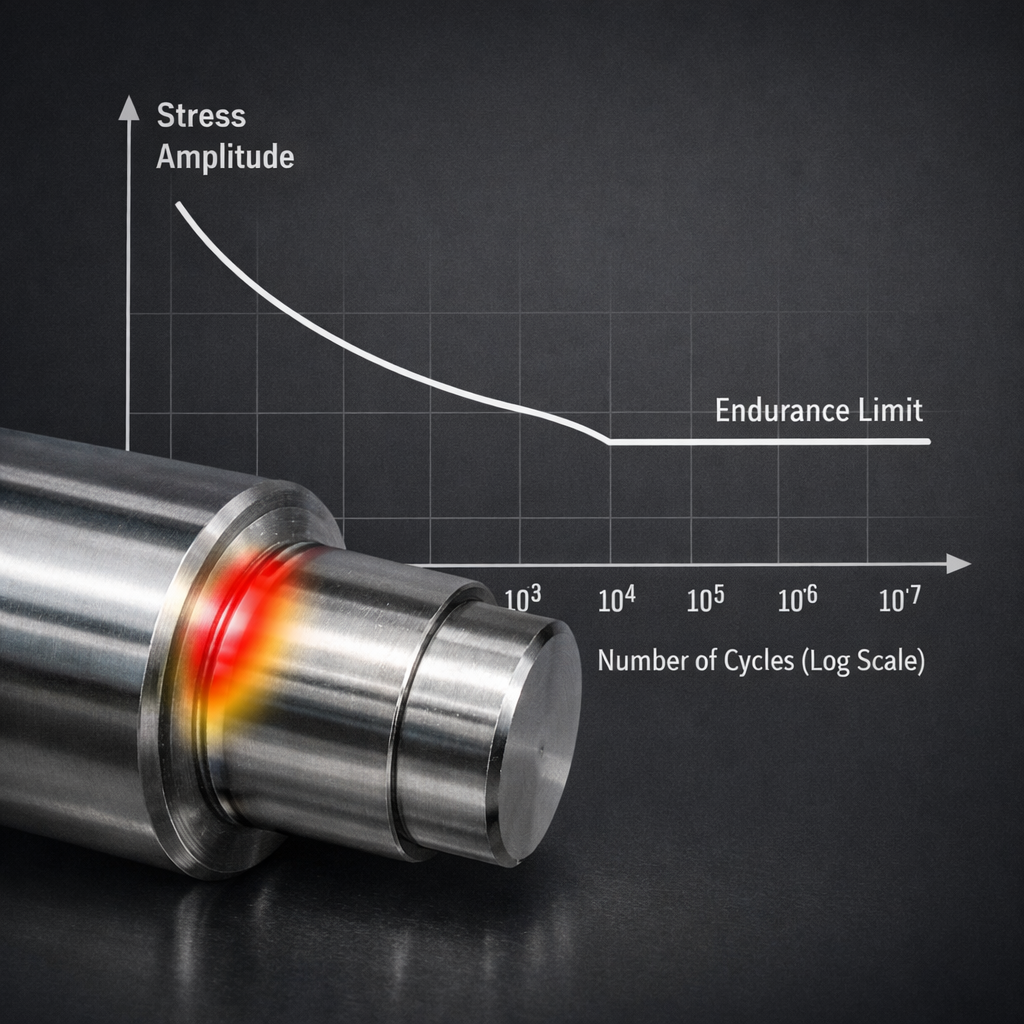
One of the most traditional approaches to fatigue analysis is the Stress-Life Method, also known as the S-N method.
In this introductory article, we outline the fundamental principles of the method, its core assumptions, and the reasons why it remains widely used in engineering practice. The objective is not to dive into detailed formulations, but to provide a structured overview of how the method works and where it fits within fatigue design.
What is it based on?
The method relies on the S-N curve, which relates:
- Stress amplitude
- Number of cycles to failure
The fundamental idea is simple:
- Higher stress → fewer cycles
- Lower stress → longer life
For steels, the curve often approaches an endurance limit, which makes it possible to design for infinite life under certain conditions.
Why engineers like it
- Simple to apply
- Requires limited material data
- Works well for high-cycle fatigue
- Suitable for preliminary shaft sizing
That is exactly why it remains widely used in mechanical design practice.
But there is an important assumption
The classical S-N curve is generated under completely reversed loading.
That means:
Mean stress σm = 0
If this assumption is not satisfied, the method must be corrected. Otherwise, the results may be unconservative. A more detailed discussion is provided in the article “Fatigue Under Fluctuating Stress”.
When is the Stress-Life Method appropriate?
- Rotating shafts under bending or torsion
- High-cycle fatigue conditions
- Components without significant plastic strain
- Early-stage design verification
It is fast.
It is practical.
It is not the most accurate method available.
But when used correctly, it remains a powerful engineering tool.
In the “Stress–Life vs Strain–Life vs LEFM” article, we look at why the S-N diagram alone is not enough for real fluctuating loads.