
In practical shaft design, loading is rarely completely reversed. Most components operate under fluctuating stresses with a non-zero mean stress.
The classical S-N diagram, however, is generated under the condition:
σm = 0
This creates a fundamental limitation.
When mean stress is present, the alternating stress must be corrected before it can be used with the S-N curve. Several failure criteria have been developed to account for this effect.
This article outlines the most widely used mean stress correction models in fatigue design.
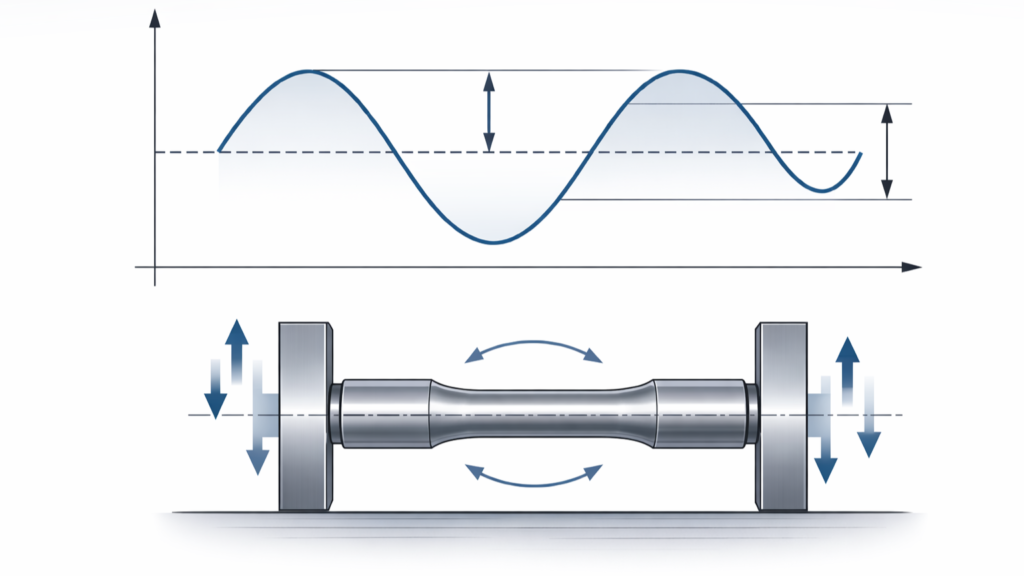
Why mean stress matters
A fluctuating stress cycle can be described by:
- Alternating stress σa
- Mean stress σm
Even if the alternating stress remains constant, an increase in tensile mean stress reduces fatigue life. Compressive mean stress, on the other hand, may improve fatigue resistance.
Therefore, the direct use of the S-N curve without correction may lead to unsafe predictions.
Goodman criterion
The Goodman relation assumes a linear interaction between alternating stress and mean stress:
σa Se + σm Sut = 1
Where:
- Se – endurance limit
- Sut – ultimate tensile strength
Characteristics:
- Linear
- Conservative
- Widely used in preliminary shaft design
It is often preferred when safety margins must be maintained.
Gerber criterion
The Gerber relation introduces a parabolic interaction:
σa Se + ( σm Sut ) 2 = 1
Characteristics:
- Non-linear
- Less conservative than Goodman
- Better agreement with experimental data for ductile materials
Gerber is often used when a more accurate estimate is required without moving to advanced models.
Morrow criterion
The Morrow relation modifies the Stress-Life approach by incorporating mean stress through the fatigue strength coefficient rather than the ultimate tensile strength.
σa Se + σm σ′f = 1
Where:
- Se – endurance limit
- σ′f – fatigue strength coefficient
Characteristics:
- Linear interaction between alternating and mean stress
- Uses fatigue strength properties instead of ultimate strength
- More suitable for finite-life analysis
Compared to Goodman, the Morrow relation replaces Sut with the fatigue strength coefficient, which provides improved correlation when detailed fatigue material parameters are available.
Smith-Watson-Topper (SWT) criterion
The Smith-Watson-Topper relation accounts for mean stress by combining maximum stress and alternating stress into a single fatigue parameter.
Se = √ σmax σa = √ (σm + σa) σa
Where:
- σa – alternating stress
- σm – mean stress
- σmax = σm + σa
Characteristics:
- Non-linear interaction between mean and alternating stress
- Considers maximum stress explicitly
- Suitable for finite-life fatigue analysis
Unlike Goodman and Gerber, which use strength ratios, the SWT model is based on a stress product parameter, providing improved correlation when both mean stress and stress amplitude significantly influence fatigue behavior.
Walker criterion
The Walker relation extends the mean stress correction by introducing a material-dependent exponent γ, allowing flexible adjustment of mean stress sensitivity.
Se = σmax1−γ σaγ = (σm + σa)1−γ σaγ
Where:
- σa – alternating stress
- σm – mean stress
- σmax = σm + σa
- γ – Walker exponent
Characteristics:
- Non-linear interaction between mean and alternating stress
- Includes a material calibration parameter γ
- Flexible fitting to experimental fatigue data
- Suitable for refined finite-life analysis
Compared to other methods, the Walker model provides greater adaptability because the exponent γ can be calibrated to match experimental fatigue behavior for specific materials.
From fluctuating stress to equivalent reversed stress
A common practical approach is to transform the fluctuating stress pair (σa, σm) into an equivalent completely reversed stress σar.
Once this equivalent stress is determined, the standard S-N procedure can be applied.
This allows engineers to retain the classical S-N framework while accounting for mean stress effects.
Selection considerations
The choice of correction method depends on:
- Required accuracy
- Available material data
- Safety philosophy
- Regulatory framework
- Type of component
For preliminary shaft sizing, Goodman is often sufficient. For refined analysis, Gerber, Morrow or Walker may be more appropriate.
Conclusion
The presence of mean stress fundamentally alters fatigue behavior and directly influences service life predictions. While the classical S-N curve provides the foundation for Stress-Life analysis, it cannot be applied directly when σm ≠ 0.
Mean stress correction models such as Goodman, Gerber, Morrow, Smith-Watson-Topper and Walker extend the applicability of the Stress-Life method to real fluctuating loading conditions. Each model is based on different assumptions and levels of conservatism, and the selection of a specific criterion should reflect the required accuracy, available material data and overall design philosophy.
In practice, the choice of fatigue model is not only a mathematical adjustment but an engineering decision that affects reliability, safety margins and predicted service life.