
Why Only Part of the Structure Actually Vibrates
In the simplified natural frequency equation:
f = 1 2π √ K M
the stiffness term is usually intuitive.
The mass term, however, is often misunderstood.
In vibration analysis of overhead cranes, the mass used in the equation is not the total physical mass of the structure. It is the equivalent modal mass participating in the specific vibration mode.
What Is Equivalent Mass?
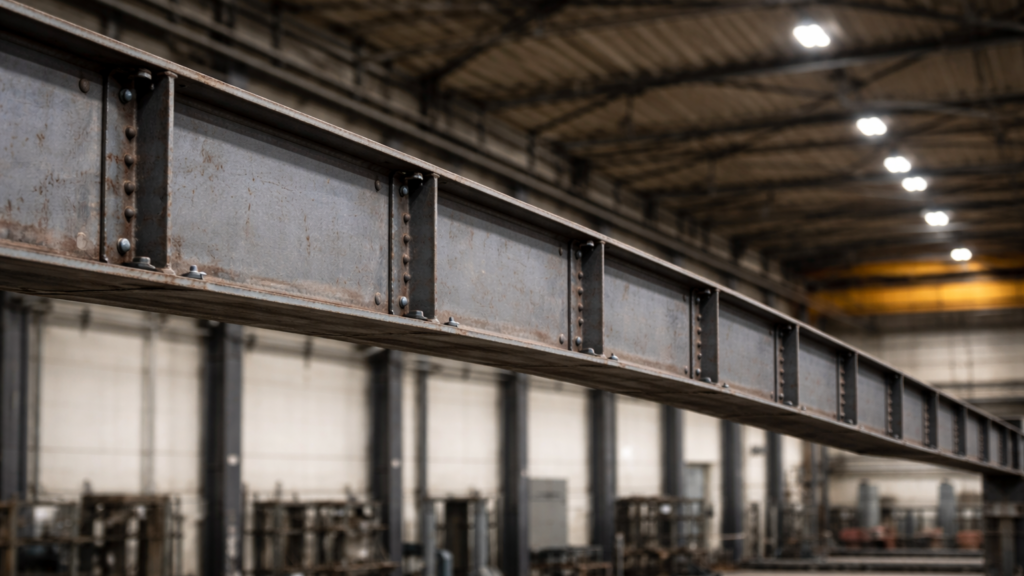
When a girder vibrates in its first bending mode, different points along the span move with different amplitudes.
- Maximum displacement occurs at mid-span
- Displacement near supports approaches zero
Because of this deformation shape, not all mass contributes equally to dynamic motion.
Equivalent mass represents the portion of total mass that effectively participates in the mode shape.
Equivalent Mass in Vertical Vibration
For vertical vibration of a simply supported girder:
M1 = 17 35 Gq + MV n
M2 = 17 35 Gq + MV + Mq n
Where:
- Gq – girder mass
- MV – trolley mass
- Mq – hook and lifted load
- n – number of girders
The coefficient:
17 35 ≈ 0.486
is derived from integration of the first bending mode shape of a simply supported beam. It reflects the modal participation factor of the distributed girder mass.
This means that only about 49% of the girder mass contributes to the first vertical bending mode.
Equivalent Mass in Horizontal Vibration
For horizontal vibration:
M3 = 0.383 Gq + MV n
The coefficient 0.383 is lower than 17/35, indicating that horizontal modal mass participation differs from vertical bending.
This difference arises from:
- Different deformation shapes
- Different bending axes
- Distribution of structural stiffness
Why Modal Mass Matters
If total physical mass were used instead of equivalent mass:
- Natural frequency would be underestimated
- Dynamic behavior would be misrepresented
Modal mass provides a realistic representation of dynamic inertia. It allows simplified analytical formulas to approximate the first vibration mode without full modal analysis.
Engineering Implications
Equivalent mass explains several practical observations:
- Adding load significantly lowers frequency
- Trolley position influences vibration
- Double-girder systems distribute mass differently
It also shows that vibration is governed by structural mode shape, not merely by total weight. This distinction becomes increasingly important for long-span cranes.
Conclusion
In vibration analysis of overhead cranes, the mass term in the natural frequency equation represents more than just the total structural weight. It reflects how the structure deforms in a specific vibration mode and which portion of the distributed mass actively participates in that motion.
Coefficients such as 17/35 and 0.383 are therefore not empirical adjustments, but direct consequences of first-mode bending theory. They capture the relationship between deformation shape and dynamic inertia, allowing simplified analytical models to approximate real structural behavior with reasonable accuracy.
A clear understanding of equivalent mass ensures that simplified vibration calculations remain physically consistent and reliable. It also explains why loading condition, girder configuration and trolley mass influence natural frequency in a predictable manner, forming a coherent framework for crane dynamic assessment.