
Local and Global Stability According to FEM 1.001
Static strength verification ensures that stresses remain within permissible limits under maximum loading.
However, even when stresses are acceptable, structural instability may still govern the design.
According to FEM 1.001, crane main girders must be verified not only for strength but also for stability, including both global and local buckling phenomena.
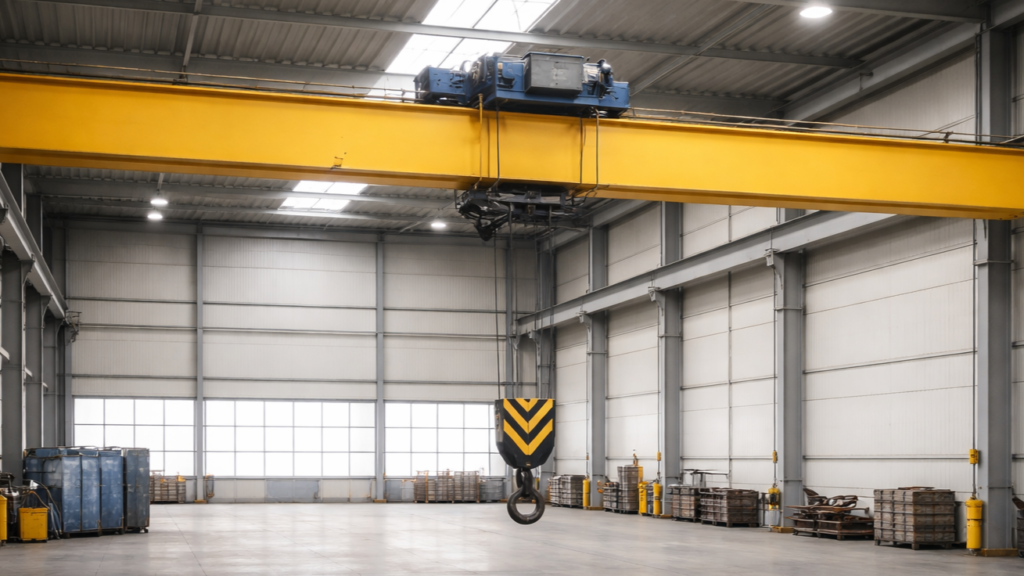
Why Stability Is Critical in Crane Girders
Crane girders are typically slender welded structures composed of:
- Flanges
- Web plates
- Stiffeners
Under bending, the upper flange is subjected to compression. Under wheel loads, the web experiences localized compressive stresses.
Slender plate elements under compression are susceptible to buckling before reaching material yield strength.
Therefore, stability checks are essential even when static stresses appear acceptable.
Global Stability
Global instability refers to overall structural behavior, such as:
- Lateral torsional buckling of the girder
- Instability due to insufficient lateral restraint
When the compression flange is not adequately restrained, the girder may deform laterally and twist under bending. The risk increases with:
- Large span-to-depth ratios
- Slender flanges
- Insufficient bracing
Global stability must therefore be evaluated in relation to support conditions and lateral restraint provided by the crane system or building structure.
Local Plate Buckling
Local buckling occurs in individual plate elements:
- Web panels between stiffeners
- Flange plates
- Unstiffened compression zones
Wheel loads introduce concentrated compressive stresses in the web. If the web plate is slender, local instability may occur before reaching the allowable stress.
For this reason, plate slenderness and stiffener arrangement play a central role in girder design.
Influence of Wheel Loads
Wheel loads introduce highly localized effects:
- Local web compression
- Combined bending and shear
- Stress concentration near load introduction
These local effects may govern web thickness and stiffener spacing.
Design must ensure that web panels remain stable under the combined action of global bending and localized wheel pressure.
Interaction Between Strength and Stability
Strength and stability are interconnected. A section may satisfy allowable stress criteria, yet fail due to:
- Plate buckling
- Lateral instability
- Interaction between compression and shear
Stability verification ensures that the structural form remains effective and that load-carrying capacity is not reduced by geometric instability.
Conclusion
Stability verification of crane main girders according to FEM 1.001 addresses both global and local buckling phenomena arising from compressive stresses in slender welded sections.
While static strength defines allowable stress levels, stability checks ensure that the girder maintains structural integrity under compression and localized wheel effects. Together, these verifications provide a comprehensive assessment of structural safety in crane girder design.