
Understanding Actions Induced by Overhead Cranes
Overhead cranes do not act on buildings as simple static loads.
They introduce a combination of vertical, horizontal and dynamic actions that vary depending on operating condition, movement and testing requirements.
For structural engineers designing runway beams, columns and supporting frames, understanding the nature of these loads is essential before any calculation begins.
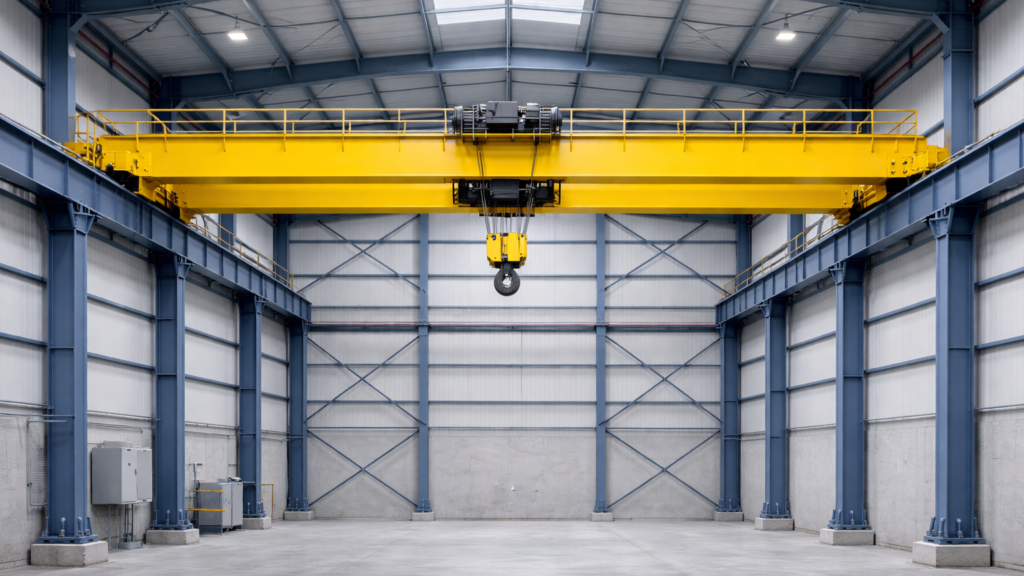
Vertical Wheel Loads
The primary action from a crane is vertical wheel load transferred to the runway beams. These loads depend on:
- Crane bridge self-weight
- Trolley weight
- Hoisted load
- Position of the trolley along the span
Because the trolley can move, wheel reactions are not constant. One wheel line may carry maximum load while the opposite side carries a reduced accompanying load.
Supporting structures must therefore be designed for both maximum and minimum wheel reactions.
Horizontal Forces from Crane Movement
Cranes generate horizontal forces during operation. These may arise from:
- Acceleration and braking of the crane bridge
- Trolley movement along the girder
- Friction between wheel and rail
Horizontal forces act both:
- Along the runway direction
- Perpendicular to it
Even though typically smaller than vertical loads, they influence:
- Lateral bending of runway beams
- Column moments
- Anchor forces
- Rail fastening systems
Dynamic Effects
Crane loads are not purely static. Dynamic amplification occurs due to:
- Hoisting acceleration
- Start and stop movements
- Impact during lifting
- Sudden unloading
These effects increase structural demand beyond simple static weight assumptions.
Design standards account for these phenomena by applying dynamic considerations to operational loads.
Test Loads and Exceptional Situations
In addition to normal operation, cranes are subjected to:
- Static test loads
- Dynamic test loads
These loads may exceed rated capacity and must be verified during structural design.
Exceptional situations, such as buffer impact at the end of travel, also introduce additional forces that affect supports and end stops.
Why Comprehensive Load Assessment Is Necessary
Crane-induced actions are:
- Moving
- Variable
- Directional
- Dynamically amplified
Treating them as simple static gravity loads can lead to unsafe simplifications. A complete assessment must consider vertical reactions, horizontal forces, dynamic effects and test conditions to ensure reliable structural performance.
Conclusion
Overhead cranes impose a complex system of loads on supporting structures, combining vertical wheel reactions, horizontal forces from movement and additional dynamic and test-related actions. Understanding the nature of these loads is the first step toward safe and efficient structural design.
Do you know that we already provide a crane wheel load calculator to help you determine these loads efficiently and consistently for your projects? You can access the tool here:
j.hojjat@gmail.com
February 26, 2026Thank you so much for the paper. it is really useful.