
End-Stop Impact Actions on Runway Structures
When an overhead crane reaches the end of its travel, impact forces may develop between the crane and the end stops. These forces are transferred through the buffers and into the runway beams and supporting structure.
Buffer forces represent accidental or extreme operational scenarios, but they must be verified in structural design.
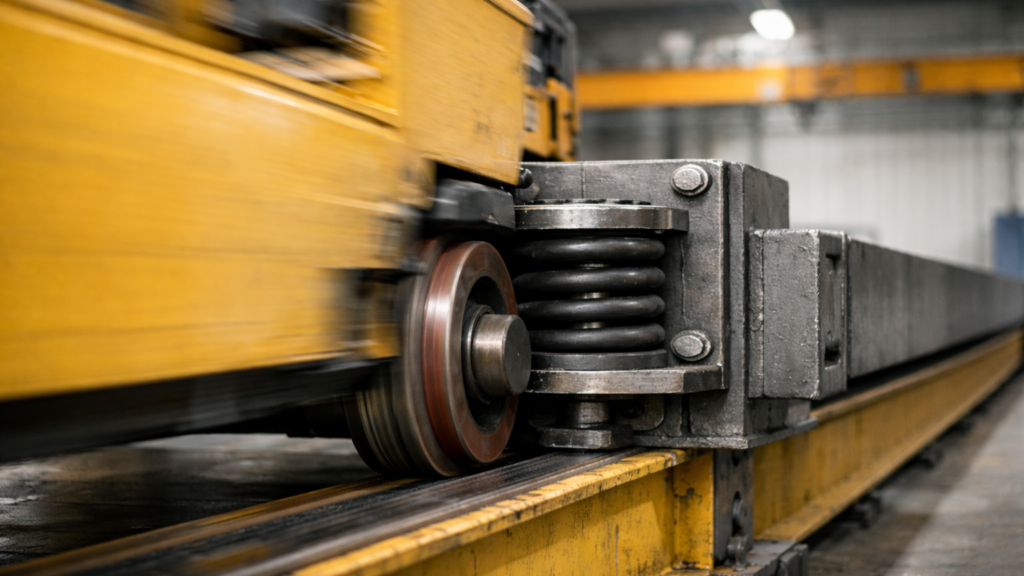
When Do Buffer Forces Occur?
Buffer forces arise when:
- The crane bridge reaches the end stop
- The trolley reaches its travel limit
- Braking distance is insufficient
- Emergency stopping occurs
Although such events are not part of normal operation, they are considered credible design situations.
Influence of Impact Velocity
Impact force depends on the velocity of the crane at the moment of contact.
The effective velocity used in design may be taken as a fraction of the nominal travel speed. This reflects the assumption that braking has already begun before contact occurs.
Higher velocity results in greater kinetic energy and therefore larger buffer force.
Role of Buffer Stiffness
Buffers act as energy-absorbing elements. The force transmitted to the structure depends on:
- Buffer stiffness
- Deformation capacity
- Total moving mass of the crane
Stiffer buffers generate higher peak forces but smaller displacements. More flexible buffers reduce peak force but allow larger movement.
Selection of buffer characteristics directly influences structural demand.
Distribution of Buffer Forces
Buffer forces are transferred:
- From crane bridge to end stops
- From end stops into runway beams
- From beams into columns and foundations
The distribution depends on:
- Number of girders
- Wheel arrangement
- Structural configuration
Both global frame response and local connection capacity must be checked.
Structural Design Implications
Buffer forces may govern:
- End stop design
- Anchor bolt capacity
- Column bending
- Local web and flange stresses
Even if vertical loads govern bending in mid-span, buffer cases often govern at supports and terminations.
These checks are essential to ensure that accidental impact does not compromise structural integrity.
Conclusion
Buffer forces represent impact actions that occur when crane motion is abruptly stopped at the end of travel. Although they are associated with rare events, their magnitude depends on crane mass, velocity and buffer stiffness, and they may govern local structural design at supports and end stops.
A complete crane load assessment must therefore include buffer forces in addition to vertical and horizontal operational loads, ensuring safe performance under both normal and extreme conditions.