
Why Lifetime Is Evaluated Differently
When discussing the Design Working Period, it is important to distinguish between two fundamentally different components of a crane:
- The load-bearing structure
- The hoisting mechanism
Although they operate together, their lifetime evaluation is based on different principles.
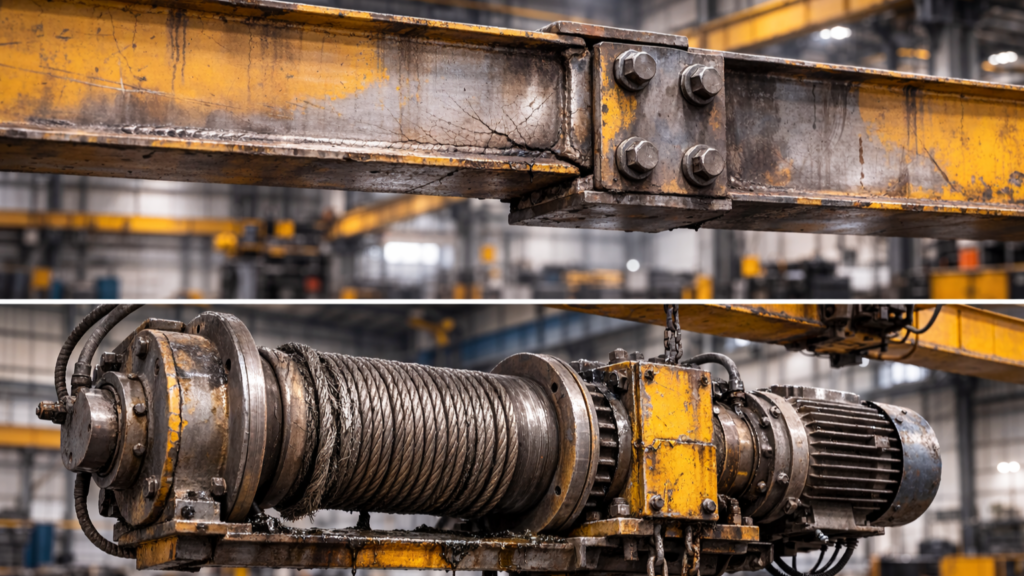
Structural Lifetime: Cycle-Based Assessment
The crane structure, including:
- Main girders
- End carriages
- Load-bearing welds
is evaluated primarily on the basis of fatigue cycles.
Each lifting operation introduces stress variation in the structure. Over time, these stress cycles accumulate fatigue damage.
Therefore, structural DWP is typically expressed in terms of:
- Number of operating cycles
- Load spectrum classification
- Fatigue demand in critical details
The governing mechanism is fatigue accumulation in welded and stressed components.
Hoist Mechanism Lifetime: Operating Time-Based Assessment
In contrast, the hoisting mechanism includes:
- Gearboxes
- Drums
- Bearings
- Motors
- Wire ropes
These components are subject to:
- Mechanical wear
- Contact stresses
- Lubrication conditions
- Thermal effects
Their lifetime is often related more closely to:
- Operating hours
- Running time
- Mechanical duty classification
While fatigue still plays a role, wear and mechanical degradation become dominant factors.
Why the Distinction Is Important
A crane structure may still have remaining fatigue capacity while the hoist mechanism has reached its mechanical limit. Or vice versa.
Assessing only one component without evaluating the other may lead to:
- Incorrect lifetime conclusions
- Incomplete safety evaluation
- Poor maintenance planning
A comprehensive DWP assessment must consider both structural fatigue and mechanical duty.
Integrated Lifetime Evaluation
Because structure and mechanism age differently, lifetime management requires:
- Structural fatigue assessment
- Mechanism duty evaluation
- Operational history review
Only by combining these aspects can the overall crane condition be realistically understood.
Conclusion
The lifetime of a crane cannot be represented by a single parameter. Structural components are governed by fatigue cycles, while hoisting mechanisms are influenced by operating time and mechanical wear.
Recognizing this distinction ensures that both structural integrity and mechanical reliability are properly evaluated when assessing the Design Working Period.
EngiSnap offers an integrated DWP evaluation covering both structural fatigue considerations and mechanism duty analysis to support safe and informed lifetime management decisions. Learn more about this service here.